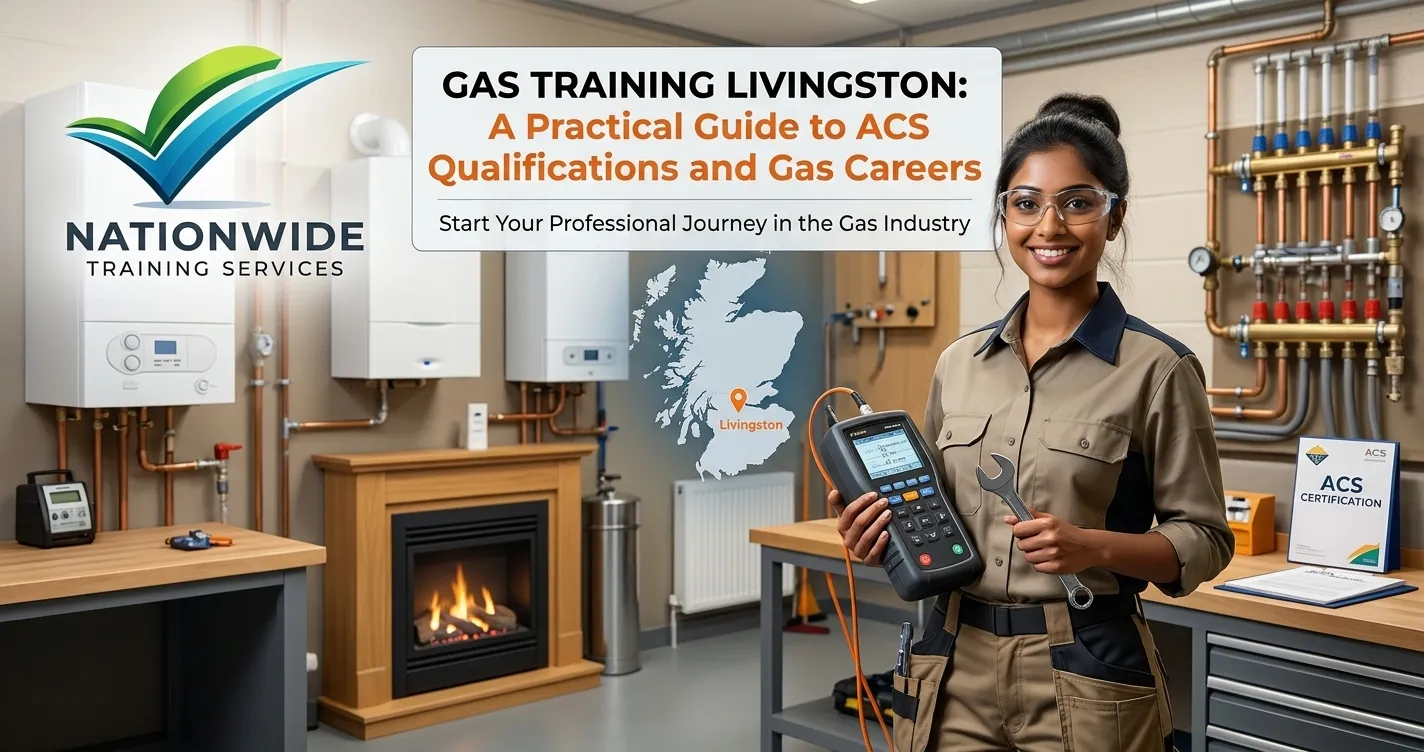
If you are searching for gas training Livingston has to offer, the short answer is simple. You can train in person at a dedicated centre, work towards nationally recognised ACS qualifications, and progress from entry level to commercial gas over time. Gas work is tightly regulated in the UK, so engineers need proven competence before they touch an appliance. This guide explains the qualifications, the routes and the practical steps, so you can choose with confidence.
It is written for new entrants, for engineers whose certificates are due for renewal, and for employers planning team training. The information reflects the courses delivered at our Livingston centre, run by Nationwide Training Services, which has over 20 years of experience delivering nationally recognised qualifications.
Quick answer: Gas training teaches engineers how to install, service and test gas appliances safely, and it leads to certification that proves their competence.
In Great Britain, gas work is legally restricted to engineers on the Gas Safe Register. Most engineers show their competence through ACS (Accredited Certification Scheme) assessments. The stakes are real, because faulty gas work can cause leaks, fires and carbon monoxide poisoning. Good training reduces that risk, protects customers and keeps engineers working within the law.
Training is also about confidence. An engineer who has practised on realistic equipment, under the eye of an experienced assessor, makes better decisions on site. That is why practical, hands-on delivery matters just as much as the certificate itself.
Quick answer: Domestic gas engineers need CCN1 (Core Domestic Gas Safety) plus the appliance modules relevant to their work.
The table below shows the main domestic ACS modules and what each one covers.
| Qualification | What it covers |
|---|---|
| CCN1 | Core domestic gas safety, the foundation for all domestic work |
| CENWAT | Central heating and hot water |
| CKR1 | Domestic cooker installation |
| HTR1 | Gas fires and wall heaters |
| CPA1 | Combustion performance analysis |
| MET1 | Domestic gas meter work |
CCN1 Core Domestic Gas Safety is the starting point. It suits engineers entering the industry, renewing existing qualifications or expanding their skills. Engineers then add the appliance modules that match the jobs they take on.
ACS certifications are valid for five years. After that, reassessment is required to stay compliant, and most reassessments can be completed within a few days. Planning renewals early helps you avoid a gap in the work you are able to carry out.
If you have no gas qualifications, the LCL Awards Domestic Gas Managed Learning Programme is designed for people beginning a career in domestic gas. It combines practical training with assessment and leads towards Gas Safe registration, which our team supports once you qualify.
Engineers who already hold ACS certificates can renew them or add new appliance categories. Some qualifications require prior experience or existing certification, so it helps to have your current certificates to hand when you speak to the team.
Once you hold domestic qualifications, you can progress to commercial certifications such as COCN1, ICPN1 and the TPCP1 modules through commercial gas training. Engineers who want to work on kitchens can look at CMET1 for commercial catering appliances. Those working with off-grid properties can extend their skills with the ACS LPG changeover programme, which requires a CCN1 qualification.
Quick answer: The process runs from a free consultation to certification, with four clear stages.
If you want to see how gas sits alongside oil, LPG, electrical and renewables routes, the training pathways page lays out the progression from entry level to advanced certification.
Livingston sits within easy reach of Edinburgh, so learners from the capital do not need to rely on online-only study. Edinburgh engineers can reach gas training Livingston courses in person, practise on real equipment, and ask questions face to face. For many people, that hands-on contact is what turns theory into usable skill.
Employers across the area can also book through us. If you need to upskill several engineers at once, group bookings and tailored packages are available.
Choosing a training provider is a trust decision, so it helps to know what stands behind the certificate. Our approach is structured, practical and built around real site conditions. Every programme is led by instructors with industry knowledge, and the focus is on competence that lasts beyond the assessment day.
Our qualifications come through recognised awarding bodies, including LCL Awards, BPEC, SQA and OFTEC, and you can read more on our accreditations page. We also advise engineers on the correct qualification for their experience, so you are not left guessing which course to book.
Gas qualifications open doors in several directions. Domestic certification gives you access to a wide range of heating and appliance work. Commercial qualifications allow you to work on larger systems in places such as offices, schools and industrial premises. LPG skills help you serve rural and off-grid properties.
Many engineers also use gas as a base for wider skills. Low carbon technologies such as air source heat pumps sit naturally alongside heating knowledge, which supports the UK’s move towards net zero.
You need CCN1 plus relevant modules such as CENWAT, CPA1, CKR1, HTR1 and MET1, depending on the appliances you will work on.
It depends on your experience and the qualifications required. Most reassessments take a few days, while full training packages take longer.
They are valid for five years, after which reassessment is required.
Our courses are primarily in person, with some elements available online depending on the qualification.
Yes. With domestic qualifications in place, you can progress to commercial certifications such as COCN1, ICPN1 and TPCP1.
Some qualifications require prior experience or existing certification. If you are unsure, the team will advise you on the correct starting point.
Fees vary by course, so please contact us for current pricing. We do not currently offer finance or payment plans, so it is worth speaking to the team before booking.
Gas training Livingston offers a clear route into one of the UK’s most important skilled trades, whether you are starting from scratch, renewing ACS certificates or moving into commercial work. The key is choosing the right qualification for your experience, then training in a practical, well-supported environment.
If you are ready to take the next step, speak to Nationwide Training Services about availability and the best course for you. You can call 01506 418798, email in**@***************************co.uk, or use the contact page. Lines are open Monday to Friday, 9am to 5pm.