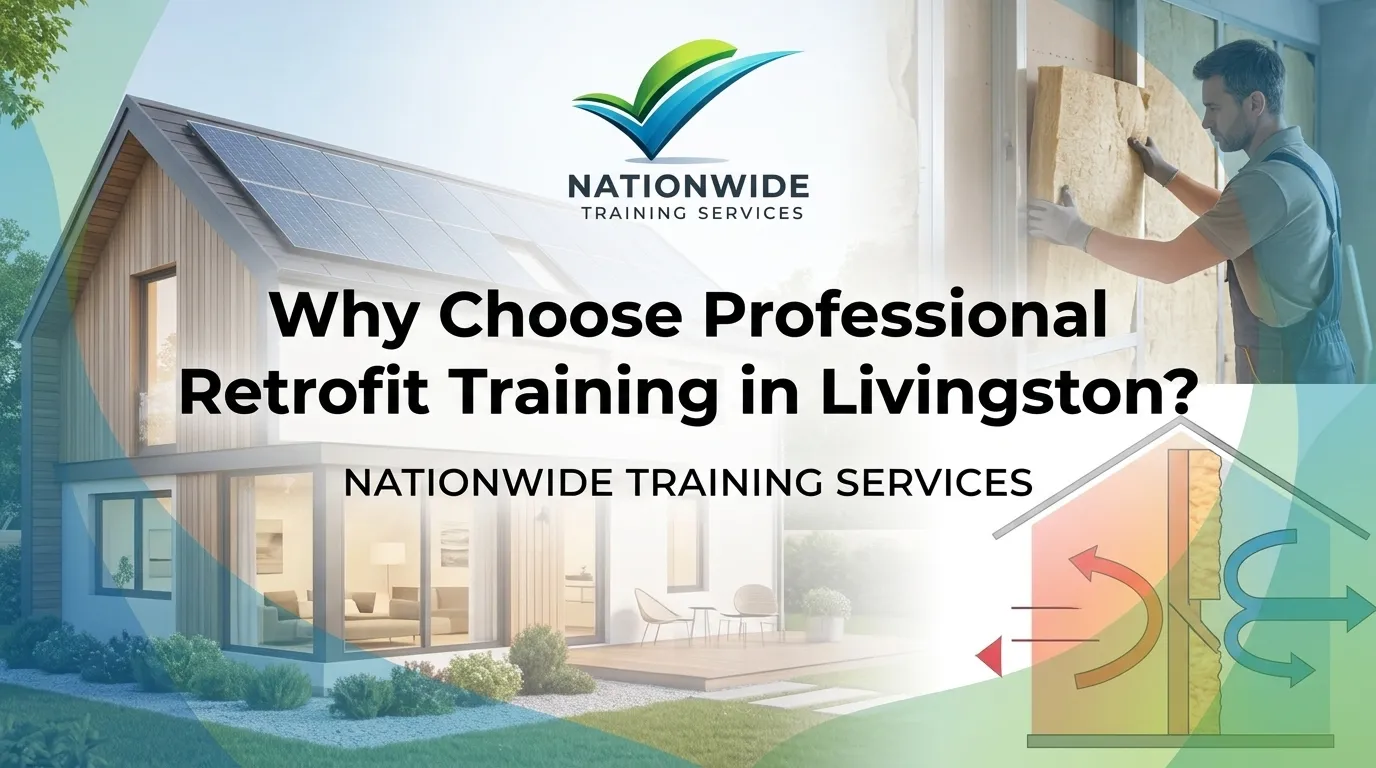
Homes across Scotland and the wider UK need to use less energy, stay warm and remain healthy to live in. That is why more tradespeople, assessors and project managers are looking at Retrofit Training Livingston providers to build the skills this work demands. The short answer to why professional training matters is that retrofit is not a single task. It is a coordinated process with defined roles, recognised standards and real risks if it is done badly. This guide explains what retrofit involves, which qualifications exist, and how to choose the right route.
It is written for installers, assessors, coordinators and employers. The information reflects the courses offered at our Livingston centre, run by Nationwide Training Services, which has over 20 years of experience delivering nationally recognised qualifications.
Quick answer: Retrofit means upgrading an existing home so it uses energy more efficiently, and professional training teaches the standards and skills needed to do that safely and correctly.
Retrofit work can include insulation, ventilation, heating upgrades and low carbon technology. The difficulty is that these measures affect one another. Adding insulation without thinking about ventilation, for example, can contribute to damp and mould. A trained professional understands these links and plans for them.
Two standards sit at the centre of domestic retrofit in the UK. PAS 2035 sets out a whole-house approach to planning and managing retrofit projects. PAS 2030 covers the installation of individual energy efficiency measures. Training that reflects both helps professionals work in a consistent, compliant way.
Quick answer: Retrofit has separate roles for installers, assessors and coordinators, and each one has its own qualification.
Because the roles differ, the right course depends on the work you do or want to do.
If you fit energy efficiency measures in existing homes, the PAS 2030 Retrofit Installer course is designed for tradespeople and installation professionals. For specific measures, the range includes ABBE Level 3 IWI for internal wall insulation and a cold roof insulation NVQ for installers working at roof level.
Assessors survey a property and inform decisions about what work should happen. The PAS 2035 Retrofit Assessor course is aimed at professionals who carry out comprehensive assessments of domestic properties. People moving into energy assessment can also look at the NOCN Level 3 Domestic Energy Assessor, our newest addition to the range.
Coordinators take responsibility for how a project is planned and managed. The PAS 2035 Retrofit Coordinator course develops the skills to coordinate projects within the framework. For a more advanced route, ABBE Level 5 Retrofit Coordination and Risk Management focuses on managing the risks that come with retrofit work.
If you are new to the subject, the NOCN Level 3 Introduction to Domestic Retrofit is a sensible first step. It builds the understanding needed to support energy-efficient, healthy homes.
Quick answer: Professional training improves work quality, supports compliance and widens the jobs you can take on.
Retrofit mistakes are expensive. Poorly installed insulation, ignored ventilation needs or unmanaged moisture can cause problems long after a job is finished. Trained professionals learn to spot those risks early.
Recognised qualifications show clients, employers and partner organisations that you have been assessed against an industry standard. After successful completion, you receive certification aligned with your qualification.
Retrofit connects with other growing areas. Engineers and tradespeople can add damp and mould surveying or domestic ventilation installation and commissioning to their skills. Those with heating experience may also explore air source heat pump training, which supports the UK’s move towards net zero.
Employers also benefit, because retrofit training Livingston teams complete together keeps project knowledge consistent across a workforce. Group bookings and tailored packages are available for housing associations, councils and contractors.
Quick answer: You move from a free consultation to certification in four stages.
To see how retrofit connects with gas, oil, electrical and renewables routes, the training pathways page shows the full progression.
Livingston sits within easy reach of Edinburgh, so learners from the capital can train without relying on online-only study. Edinburgh professionals can reach retrofit training Livingston courses in person, work through practical topics with an instructor and ask questions as they arise. For a subject built on real buildings and real constraints, that face-to-face contact makes a difference.
Choosing a training provider is a decision based on trust, so it helps to know what stands behind the certificate. Our approach is structured and practical, with every programme led by instructors who understand the sector. The focus is on competence that lasts beyond assessment day.
Qualifications come through recognised awarding bodies, and you can read more on our accreditations page. We also advise on the right course for your experience, so you are not left guessing which qualification to book.
Retrofit training teaches the skills and standards needed to improve existing homes so they are more energy efficient. Courses are aimed at installers, assessors and coordinators, and each role has its own qualification.
PAS 2030 relates to installing energy efficiency measures, while PAS 2035 relates to assessing and coordinating retrofit projects. Separate courses cover each role.
Some qualifications require prior experience or existing certification. If you are unsure, our team will advise you on the correct starting point.
Our courses are primarily in person, with some elements available online depending on the qualification.
Yes. After successful completion, you receive recognised certification aligned with your qualification.
Fees vary by course, so please contact us for current pricing. We do not currently offer finance or payment plans, so it is worth speaking to the team before booking.
Retrofit training Livingston offers a structured way into one of the most important areas of the built environment, whether you install measures, assess homes or manage projects. The right qualification, delivered in a practical setting, helps you work safely, meet standards and take on a wider range of jobs.
If you are ready to take the next step, speak to Nationwide Training Services about availability and the best course for your role. You can call 01506 418798, email in**@***************************co.uk, or use the contact page. Lines are open Monday to Friday, 9am to 5pm.